A Mac app for writing your whole book.
Wryte is for novels, short stories, non-fiction and theses. Chapters and scenes go down the side, each scene gets an index card, Focus Mode gives you one page to write on, and Export turns the lot into a manuscript in standard format. No AI. Nothing leaves your Mac.
On the Mac App Store macOS 15 Sequoia or later Price to come
⌘1 ⌘2 ⌘3
Read Through,
Cards, Outline
Three ways to see a chapter.
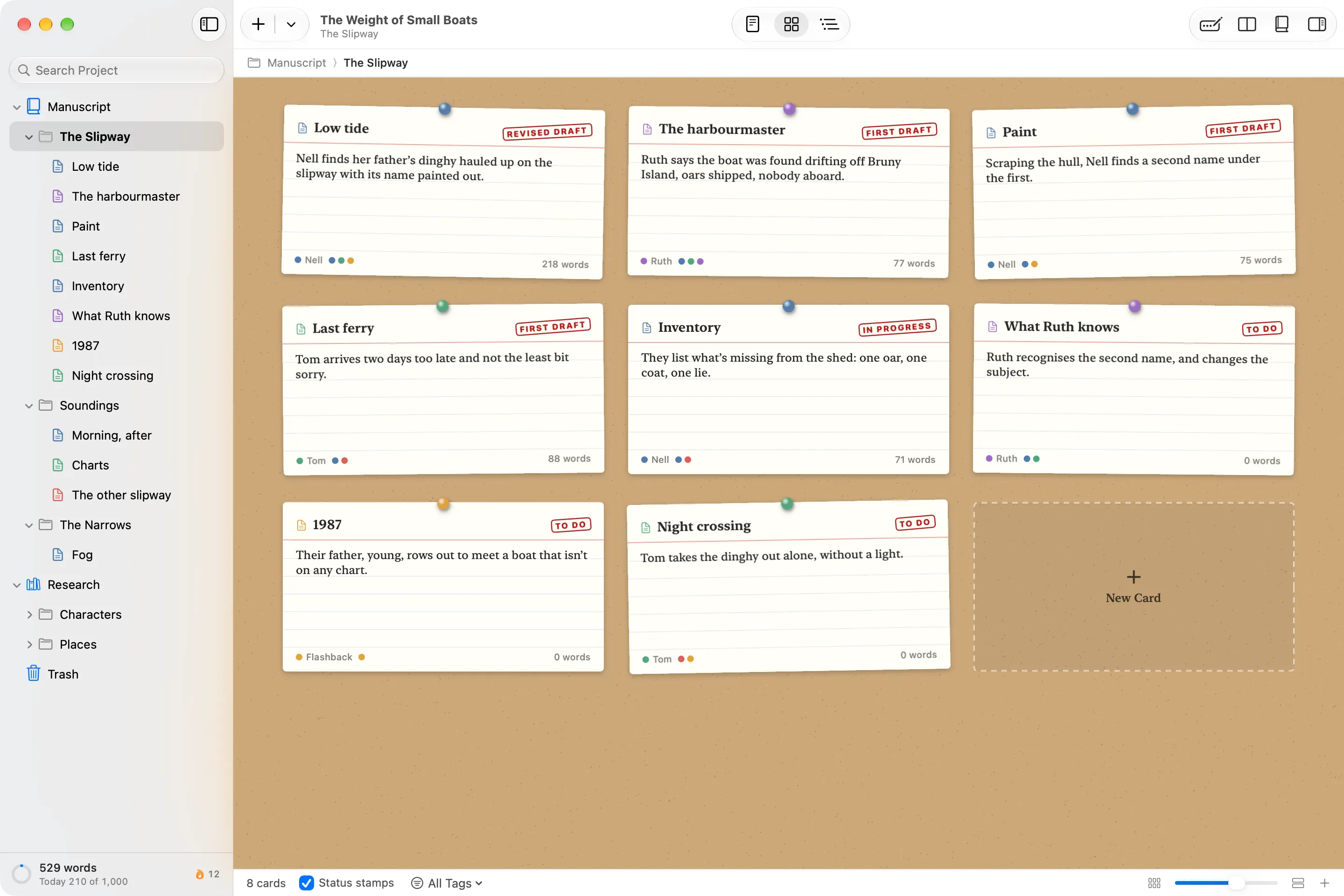
Click a chapter to read it straight through, see its scenes as index cards, or list them in an outline you can edit in place. In Wryte, dragging a card moves its scene within the chapter. The sample below lets you switch between the three views.
The Weight of Small Boats / Manuscript / The Slipway
The Slipway
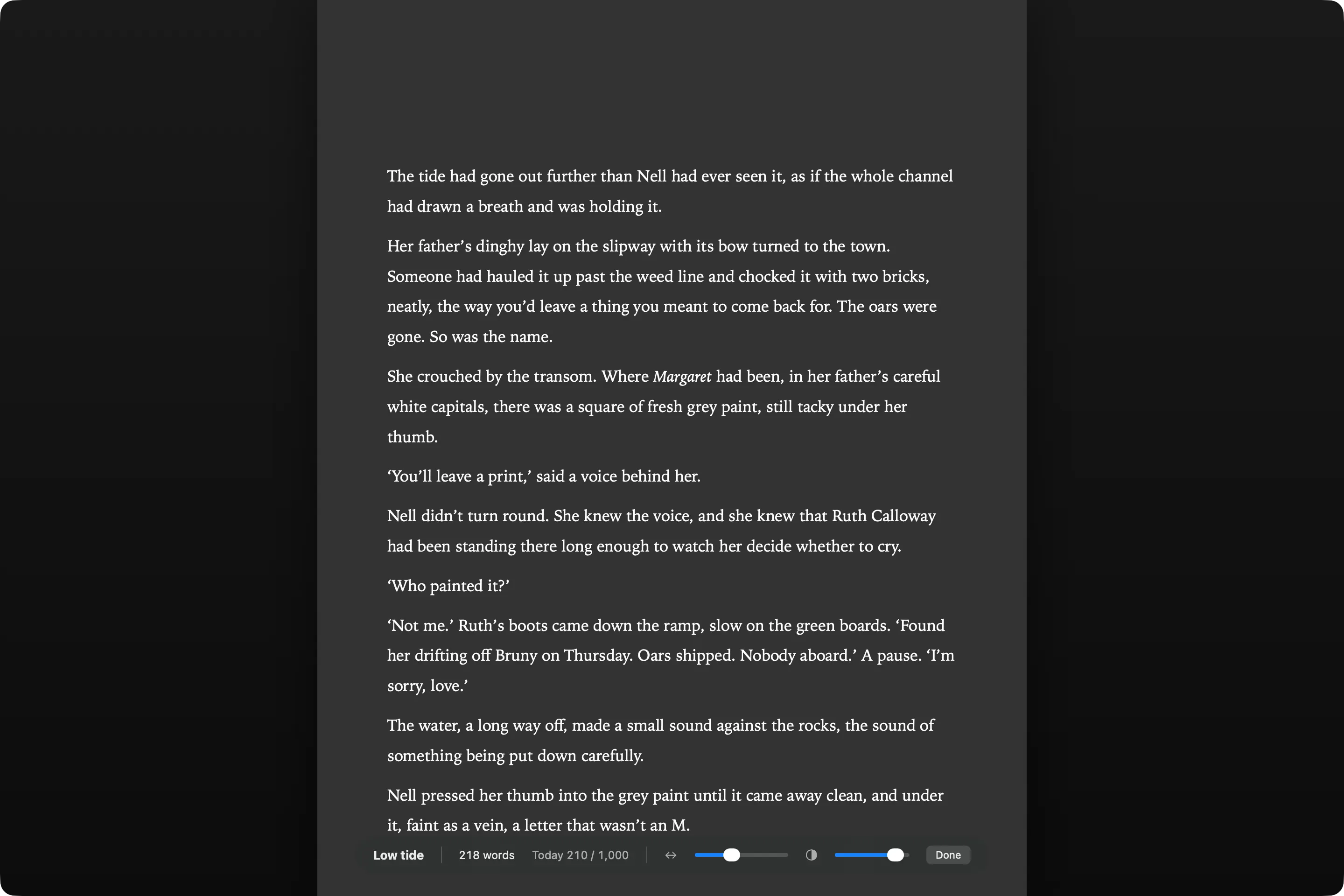
The tide had gone out further than Nell had ever seen it, as if the whole channel had drawn a breath and was holding it.
Her father’s dinghy lay on the slipway with its bow turned to the town. Someone had hauled it up past the weed line and chocked it with two bricks, neatly, the way you’d leave a thing you meant to come back for. The oars were gone. So was the name.
She crouched by the transom. Where Margaret had been, in her father’s careful white capitals, there was a square of fresh grey paint, still tacky under her thumb.
‘You’ll leave a print,’ said a voice behind her.
Nell didn’t turn round. She knew the voice, and she knew that Ruth Calloway had been standing there long enough to watch her decide whether to cry.
‘Who painted it?’
‘Not me.’ Ruth’s boots came down the ramp, slow on the green boards. ‘Found her drifting off Bruny on Thursday. Oars shipped. Nobody aboard.’ A pause. ‘I’m sorry, love.’
The water, a long way off, made a small sound against the rocks, the sound of something being put down carefully.
Nell pressed her thumb into the grey paint until it came away clean, and under it, faint as a vein, a letter that wasn’t an M.
Ruth kept the harbour office the way other people kept a diary: every boat in, every boat out, the weather in the margin. Nell had grown up reading it upside down across the desk.
Thursday’s page said only Margaret, found adrift, 7.40 a.m., towed in. The handwriting was steady. The ink was not quite the same blue as the rest.
‘You wrote this later,’ Nell said.
Ruth closed the book. ‘I wrote it when I had time.’
It took the whole afternoon and most of a tin of stripper. The grey came off in soft curls, then her father’s white, then a blue she’d never seen on any boat of his.
The second name was shorter. Four letters, done by someone in a hurry, the last one trailing off the edge of the plank.
She sat back on her heels and read it twice, and then she went to find a phone.
Tom came off the last ferry with one bag and the look he’d worn since he was nine, the look that said whatever this was, it had started without him.
‘Two days,’ Nell said.
‘The roads were shut.’ He looked past her at the slipway. ‘Is that her?’
‘That’s her.’
He didn’t go down. He lit a cigarette instead, cupping it against a wind that wasn’t there, and Nell understood that he had already decided not to be sorry about anything until he’d been told what it was.
They made the list on the back of a tide table, because it was the only paper in the shed.
One oar, the left. One oilskin coat, the old yellow one. The good torch. Their father’s reading glasses, which he never took out on the water.
‘That’s not missing,’ Tom said, when she wrote the last line. ‘That’s just something you think.’
She left it on the list anyway: one lie.
Low tide
Revised DraftNell finds her father’s dinghy hauled up on the slipway with its name painted out.
Nell218 words
The harbourmaster
First DraftRuth says the boat was found drifting off Bruny Island, oars shipped, nobody aboard.
Ruth77 words
Paint
First DraftScraping the hull, Nell finds a second name under the first.
Nell75 words
Last ferry
First DraftTom arrives two days too late and not the least bit sorry.
Tom88 words
Inventory
In ProgressThey list what’s missing from the shed: one oar, one coat, one lie.
Nell71 words
What Ruth knows
To DoRuth recognises the second name, and changes the subject.
Ruth0 words
1987
To DoTheir father, young, rows out to meet a boat that isn’t on any chart.
Flashback0 words
Night crossing
To DoTom takes the dinghy out alone, without a light.
Tom0 words
| Title | Synopsis | Status | Words |
|---|---|---|---|
| Low tide | Nell finds her father’s dinghy hauled up on the slipway with its name painted out. | Revised Draft | 218 |
| The harbourmaster | Ruth says the boat was found drifting off Bruny Island, oars shipped, nobody aboard. | First Draft | 77 |
| Paint | Scraping the hull, Nell finds a second name under the first. | First Draft | 75 |
| Last ferry | Tom arrives two days too late and not the least bit sorry. | First Draft | 88 |
| Inventory | They list what’s missing from the shed: one oar, one coat, one lie. | In Progress | 71 |
| What Ruth knows | Ruth recognises the second name, and changes the subject. | To Do | 0 |
| 1987 | Their father, young, rows out to meet a boat that isn’t on any chart. | To Do | 0 |
| Night crossing | Tom takes the dinghy out alone, without a light. | To Do | 0 |
| 8 scenes | 529 |
A sample novel, written for this page. In Wryte, the same three views work on any folder.
⇧⌘↩
Focus Mode
Focus Mode hides everything but the page.
Typewriter scrolling keeps the line you’re writing in the middle of the screen, so your eyes stay in one place. An empty page shows a faint prompt to get you going (“A first draft only has to exist.”), and it disappears when you type. Press Esc and your whole book is back where you left it.
Stet
(let it stand)
Wryte leaves your words alone.
- Wryte has no AI. It never writes, rewrites or suggests a word.
- Your writing is never uploaded, collected or used to train anything.
- Your book lives in files you own, on your Mac or in your own iCloud Drive.
- No accounts, no analytics, no tracking.
- It only goes online when you save a web page into your Research folder.
⌥⌘E
Export
Export for an agent, a printer or an e-reader.
Export turns your manuscript into a finished file, with a preview that updates as you change the settings. There are four starting points:
- Submission: a Word document in standard manuscript format, for agents and editors.
- Paperback: a print-ready PDF at 5 × 8, 5.5 × 8.5 or 6 × 9 inches.
- Ebook: an EPUB for e-readers, with your cover.
- Draft: a quick PDF to read through.
⇧⌥⌘E
Send to Editor
Tracked changes for your editor.
Save a checkpoint before you send a draft. Next time, Send to Editor makes a Word document with everything you’ve changed since then marked as tracked changes, so your editor can see what’s new.
Low tide.docx · tracked changes since the checkpoint of 26 October
Her father’s dinghy lay on the slipway with its bow turned to the town. Someone had hauled it up past the weed line and chocked it with two bricks, carefully, as if they meant to come backneatly, the way you’d leave a thing you meant to come back for. The oars were gone. So was the name.
She crouched by the transom. Where Margaret had been, in her father’s careful white capitals, there was a square of fresh grey paint that hadn’t been there on Sunday, still tacky under her thumb.
Start from a template.
There are templates for a novel, short stories, non-fiction, and a thesis or paper, or you can start from a blank page. Change anything a template sets up as you go.
Coming from Scrivener?
If you’ve used Scrivener, you’ll find its binder, corkboard, Scrivenings, snapshots and split editor here under plainer names. Export is simpler, and Wryte can’t open Scrivener projects, so read the comparison before you move a book across.